

The Public Works Department (PWD) advocated for the role of the government in providing a widespread and reliable supply of electricity for both urban and rural areas through studies, surveys, and reports created in the early twentieth century. At the time, comparatively modest and isolated generating systems run by local councils or private enterprises provided electricity for specific localities. The PWD focused closely on the development of hydropower to meet the nation’s needs. This resulted in the design and construction of the first government-funded hydroelectric power station at Lake Coleridge in Canterbury (1911-15), under the direction of resident water engineer Frederick Kissel.
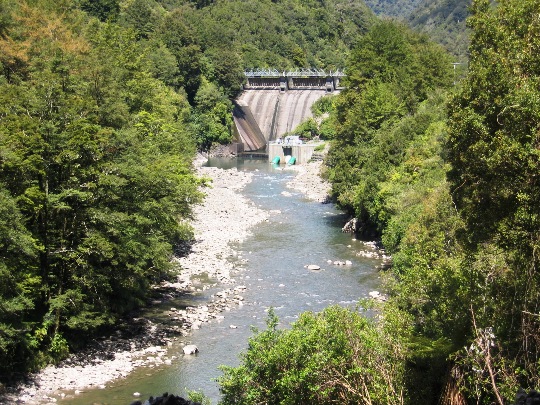
Survey work for the Mangahao hydroelectric power scheme began in 1915, but the realisation of Kissel’s plan would not begin in earnest until after World War I. In April 1921, over 200 men were working on the project; by February 1923, almost 900 men worked in eight hour shifts covering twenty-four hours per day. On 3 November 1924, Prime Minister William Massey officially opened the power station in a day-long celebration attending by numerous national and local officials. The scheme also included dams and reservoirs, a tunnel, an open surge chamber, steel penstocks and a tailrace.
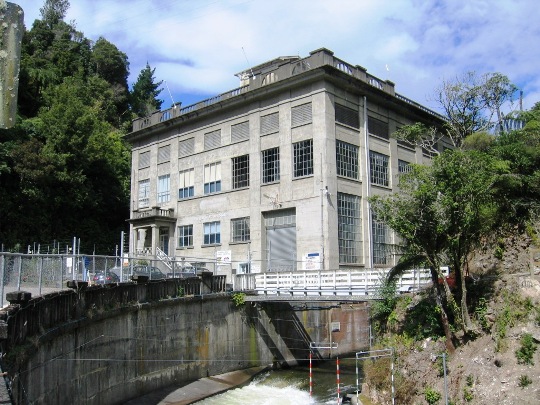
The imposing concrete powerhouse at Mangaore is 84 metres long by 24.4 metres wide by 16.1 metres high. The exterior style was typical for industrial architecture of the age with its largely utilitarian character enlivened by classical elements: a raised entrance portico on the north wall, a decorative balustrade along the roofline just above the cornice, and the three levels of regularly spaced window openings (fitted with steel sash) organized into vertical bays separated by plain pilasters rising up from the ground through to the cornice.
The powerhouse and its tailrace appear to remain largely intact to their period of original construction, which included the straightening of a bend in the Mangaore Stream in the vicinity of the powerhouse. Additional seismic upgrades, including the replacement of a portion of the roof parapet and the construction of two transverse sheer walls, began in 2015.
List Entry Information
Status
Listed
List Entry Status
Historic Place Category 2
Access
Private/No Public Access
List Number
4066
Date Entered
5th September 1985
Date of Effect
5th September 1985
City/District Council
Horowhenua District
Region
Horizons (Manawatū-Whanganui) Region
Extent of List Entry
Extent includes part of the land described as Sec 1 SO 37751 (RT WN52A/811), Wellington Land District, and the building known as Mangahao Hydroelectric Power Station thereon. Refer to the extent map tabled at the Rarangi Korero Committee meeting on 9 March 2017.
Legal description
Sec 1 SO 37751 (RT WN52A/811), Wellington Land District
Status
Listed
List Entry Status
Historic Place Category 2
Access
Private/No Public Access
List Number
4066
Date Entered
5th September 1985
Date of Effect
5th September 1985
City/District Council
Horowhenua District
Region
Horizons (Manawatū-Whanganui) Region
Extent of List Entry
Extent includes part of the land described as Sec 1 SO 37751 (RT WN52A/811), Wellington Land District, and the building known as Mangahao Hydroelectric Power Station thereon. Refer to the extent map tabled at the Rarangi Korero Committee meeting on 9 March 2017.
Legal description
Sec 1 SO 37751 (RT WN52A/811), Wellington Land District
Construction Professional
Name
Kissel, Frederick Templeton Manheim
Type
Engineer
Biography
The preliminary and final design of the Arapuni power development is attributed to Frederick Kissel (1881-1962). Born in Templeton, New Zealand, Kissel began his engineering career with the Public Works Department having graduated from Canterbury University College in 1905. In 1911 he was engineer-in-charge of the first installation at Lake Coleridge and in 1922 was sent abroad to gain experience in the latest practices in hydro-electric engineering. Shortly after his return to New Zealand he was appointed Chief Electrical Engineer to the Public Works Department and upon the formation of the State Hydro-electric Department in 1945 was made its first General Manager. Kissel specialised in the development of water power, and from the small beginning in state enterprise at Lake Coleridge, he guided the expansion of the electric generation system throughout New Zealand. After his retirement in 1948 he continued in engineering and for several years was a director of William Cable Holdings. In 1932 Kissel served as President of the New Zealand Society of Civil Engineers. The contracts for the construction of the Arapuni dam, headrace, weir and power house was let to the British firm of Sir W G Armstrong, Whitworth and Co. The company's traditional field of expertise was ordinance and mechanical engineering, but following World War Two it diversified into civil engineering on a world wide scale. In New Zealand it had also constructed the Waihi-Tauranga section of the East Coast railway. The company experienced difficulties with the dam contract, and they received a release from the power house contract. This work was completed by the Public Works Department, under the control of F W Furkert, engineer-in-chief, who later was in charge of remedial work at the site.
Construction Details
Type
Modification
Description
Replacement of the stair balustrade at the entrance and some replacement sash on north elevation
Period
Unknown
Start Year
1983
Type
Structural upgrade
Description
Seismic strengthening (interior steel bracing)
Type
Modification
Description
Francis turbine replaces Pelton turbines with some alterations to the exit to the tailrace
Period
1992-94
Start Year
2015
Type
Structural upgrade
Description
Seismic strengthening (replaced roof balustrade and addition of sheer walls)
Construction Professional
Name
Kissel, Frederick Templeton Manheim
Type
Engineer
Biography
The preliminary and final design of the Arapuni power development is attributed to Frederick Kissel (1881-1962). Born in Templeton, New Zealand, Kissel began his engineering career with the Public Works Department having graduated from Canterbury University College in 1905. In 1911 he was engineer-in-charge of the first installation at Lake Coleridge and in 1922 was sent abroad to gain experience in the latest practices in hydro-electric engineering. Shortly after his return to New Zealand he was appointed Chief Electrical Engineer to the Public Works Department and upon the formation of the State Hydro-electric Department in 1945 was made its first General Manager. Kissel specialised in the development of water power, and from the small beginning in state enterprise at Lake Coleridge, he guided the expansion of the electric generation system throughout New Zealand. After his retirement in 1948 he continued in engineering and for several years was a director of William Cable Holdings. In 1932 Kissel served as President of the New Zealand Society of Civil Engineers. The contracts for the construction of the Arapuni dam, headrace, weir and power house was let to the British firm of Sir W G Armstrong, Whitworth and Co. The company's traditional field of expertise was ordinance and mechanical engineering, but following World War Two it diversified into civil engineering on a world wide scale. In New Zealand it had also constructed the Waihi-Tauranga section of the East Coast railway. The company experienced difficulties with the dam contract, and they received a release from the power house contract. This work was completed by the Public Works Department, under the control of F W Furkert, engineer-in-chief, who later was in charge of remedial work at the site.
Construction Details
Type
Modification
Description
Replacement of the stair balustrade at the entrance and some replacement sash on north elevation
Period
Unknown
Start Year
1983
Type
Structural upgrade
Description
Seismic strengthening (interior steel bracing)
Type
Modification
Description
Francis turbine replaces Pelton turbines with some alterations to the exit to the tailrace
Period
1992-94
Start Year
2015
Type
Structural upgrade
Description
Seismic strengthening (replaced roof balustrade and addition of sheer walls)
Historical and Associated Iwi / Hapū / Whānau
Completion Date
19th January 2017
Report Written By
James A. Jacobs
Information Sources
Dictionary of New Zealand Biography
Dictionary of New Zealand Biography
Evening Post
Evening Post, 27 Jun 1919, p.7.
Institute of Professional Engineers in NZ (IPENZ)
Institute of Professional Engineers in NZ
Martin, 1991
People, Politics & Power Stations: Electric Power Generation in New Zealand 1880-1990, ed. John E. Martin, Bridget Williams Books and Electricity Corporation of New Zealand, Wellington, 1991.
Other Information
This place was identified as significant under previous legislation with different information requirements. It remains significant under the current legislation. There is opportunity under our legislation and policies to add to this information. Further information about this place may be available from the Central Regional Office of Heritage New Zealand Pouhere Taonga. Please note that entry on the New Zealand Heritage List/Rarangi Korero identifies only the heritage values of the property concerned, and should not be construed as advice on the state of the property, or as a comment of its soundness or safety, including in regard to earthquake risk, safety in the event of fire, or insanitary conditions. A fully referenced upgrade report is available on request from the Central Region Office of Heritage New Zealand.
Historical and Associated Iwi / Hapū / Whānau
Completion Date
19th January 2017
Report Written By
James A. Jacobs
Information Sources
Dictionary of New Zealand Biography
Dictionary of New Zealand Biography
Evening Post
Evening Post, 27 Jun 1919, p.7.
Institute of Professional Engineers in NZ (IPENZ)
Institute of Professional Engineers in NZ
Martin, 1991
People, Politics & Power Stations: Electric Power Generation in New Zealand 1880-1990, ed. John E. Martin, Bridget Williams Books and Electricity Corporation of New Zealand, Wellington, 1991.
Other Information
This place was identified as significant under previous legislation with different information requirements. It remains significant under the current legislation. There is opportunity under our legislation and policies to add to this information. Further information about this place may be available from the Central Regional Office of Heritage New Zealand Pouhere Taonga. Please note that entry on the New Zealand Heritage List/Rarangi Korero identifies only the heritage values of the property concerned, and should not be construed as advice on the state of the property, or as a comment of its soundness or safety, including in regard to earthquake risk, safety in the event of fire, or insanitary conditions. A fully referenced upgrade report is available on request from the Central Region Office of Heritage New Zealand.
Current Usages
Uses: Utilities
Specific Usage: Electricity Power Station
Web Links
description: Engineering NZ Heritage
url: https://www.engineeringnz.org/our-work/heritage/heritage-records/mangahao-power-station/
Current Usages
Uses: Utilities
Specific Usage: Electricity Power Station
Web Links
description: Engineering NZ Heritage
url: https://www.engineeringnz.org/our-work/heritage/heritage-records/mangahao-power-station/
Sign up to hear more
Get the latest heritage news, features and events delivered
straight to your inbox.
